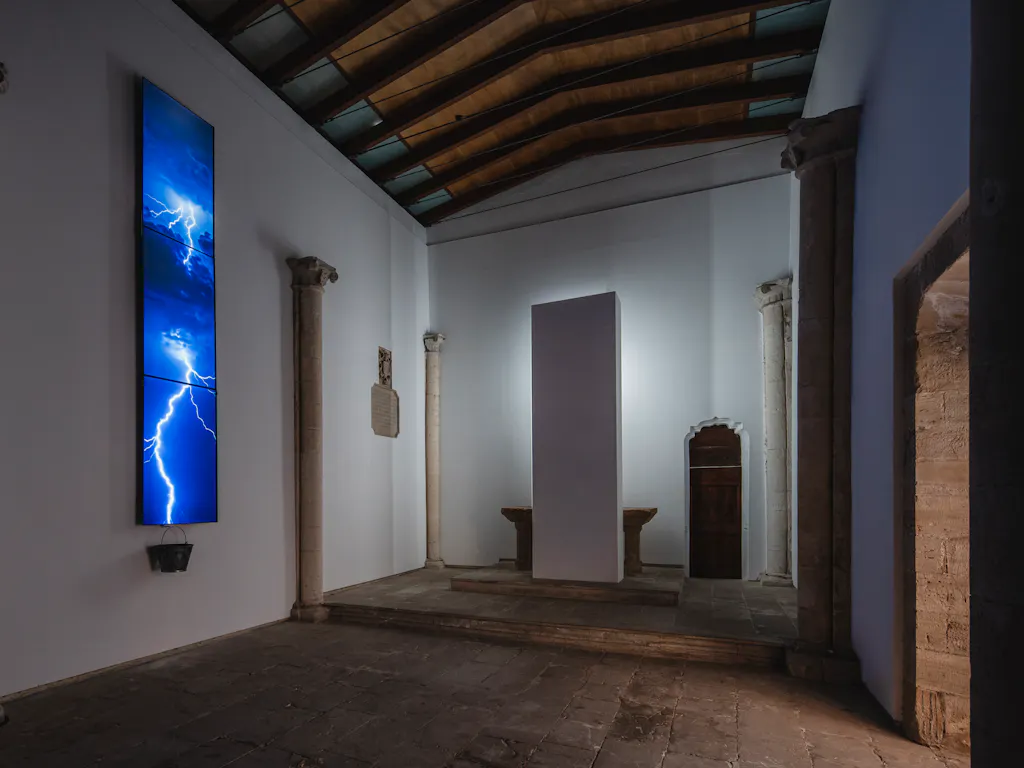
Of that collapse, only two blocks remain standing. Rigorously vertical, it behaves like a screen- wall. Across its surface bounces, persists, and insists the luminescence produced by the continuous flash of lightning in the video installation Plessi conceived for this project.
The serene, suspended space of the Oratory becomes the meeting point of two colliding verticalities: a black one that expels the image and yet reflects it; a white one that absorbs it and, at the same time, conceals it. These are not two works. They are two images returning to a place they never were. Images always arrive late, because they are like the scars of a journey yet to be made.
"Energy" (2026) by Fabrizio Plessi consists of three screens stacked one above another, accumulating vertigo. Against an overwhelmingly dense black, the lightning traces an incessant filigree. The screen's surface then becomes a mirror in which our faces appear, cracked, intermittent, returned to their pointed solitude. The ancient Greeks said that every mirror preserves in its silvering the trace of Persephone.
The speed of lightning is the speed of the hand that draws and tries to seize an idea before it vanishes. An unhesitating hand, tracing lines like claw marks. That is why the line is faster than thought — otherwise, thought would annihilate it. The bolt of lightning is the wound of the night, like a stray burst of luminosity. An incision that brings the upper part of the world into contact with the lower part. The instant in which the two extremes recognise each other.
Plessi's work insists on that instant. It is a repeated, stubborn gesture, with no possible redemption — an open crack in the darkness, waiting for the image. Like the cracks that run through Malevich's Black Square, which, far from destroying it, let the latency of what it covers show through: the gold of Byzantine icons. Plessi speaks of an energy capable of altering the lapidary order of things, of intervening in it to extend its potential. Here, that glow is held within a cube of galvanised iron, saturated with shadows, filled with black paint — a blackness that contains all the paintings.
But in the Oratory there is still an altar. And behind an altar there is always an image: the venerated image. The image that orders and binds together two worlds unknown to each other: the one above and the one below. The image as a place of transit, a device of devotion and limit. Bernardí Roig's sculpture "The Man with the Golden Arm" (2026) has been withdrawn from view. It is not hidden but waiting; trapped between the altar and the block of coagulated light, suspended in the interval of appearance. Because the non-negotiable condition of every image is to be seen, though that is no guarantee of presence.
The figure, of medium scale, neither large nor small, remains upside down. Entrenched from the world and given over to an extensive solitude. It has one arm of gold — the same gold as the Byzantine mosaic of the Ascension in the dome of the Basilica of San Marco in Venice. A right arm, corrupt yet heroic, ready to trace the line and capture contours. It is the last fragment of the body in which drawing can still place its trust.
The figure, isolated and persistent, is caught in a loop between visibility and concealment, between the drive to show itself and the impulse to disappear. Being inverted, it does not descend but ascends upside down, trying to enclose its face within its own head. It does not profane the place — and if it does, it is only to lay claim, with greater intensity, to the sacred. What must be seen always lacks an image. That is why we make them: to bear the polyphony of the snores we have inherited.